

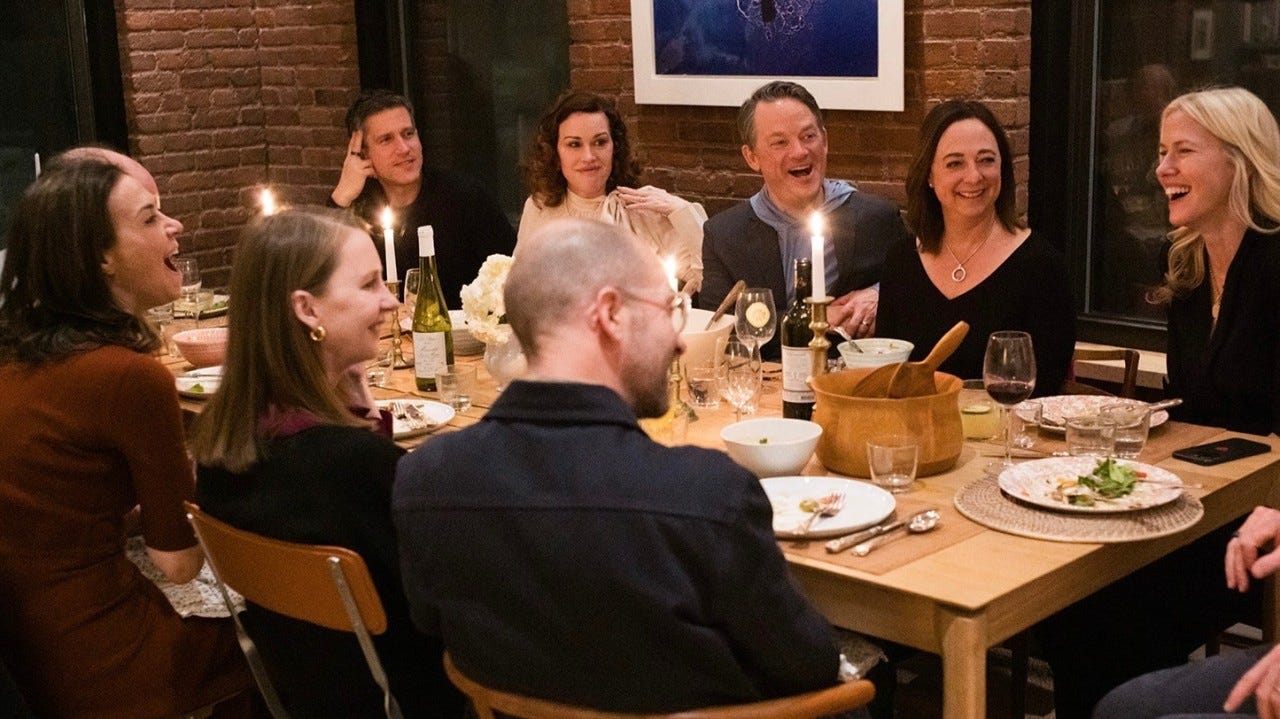
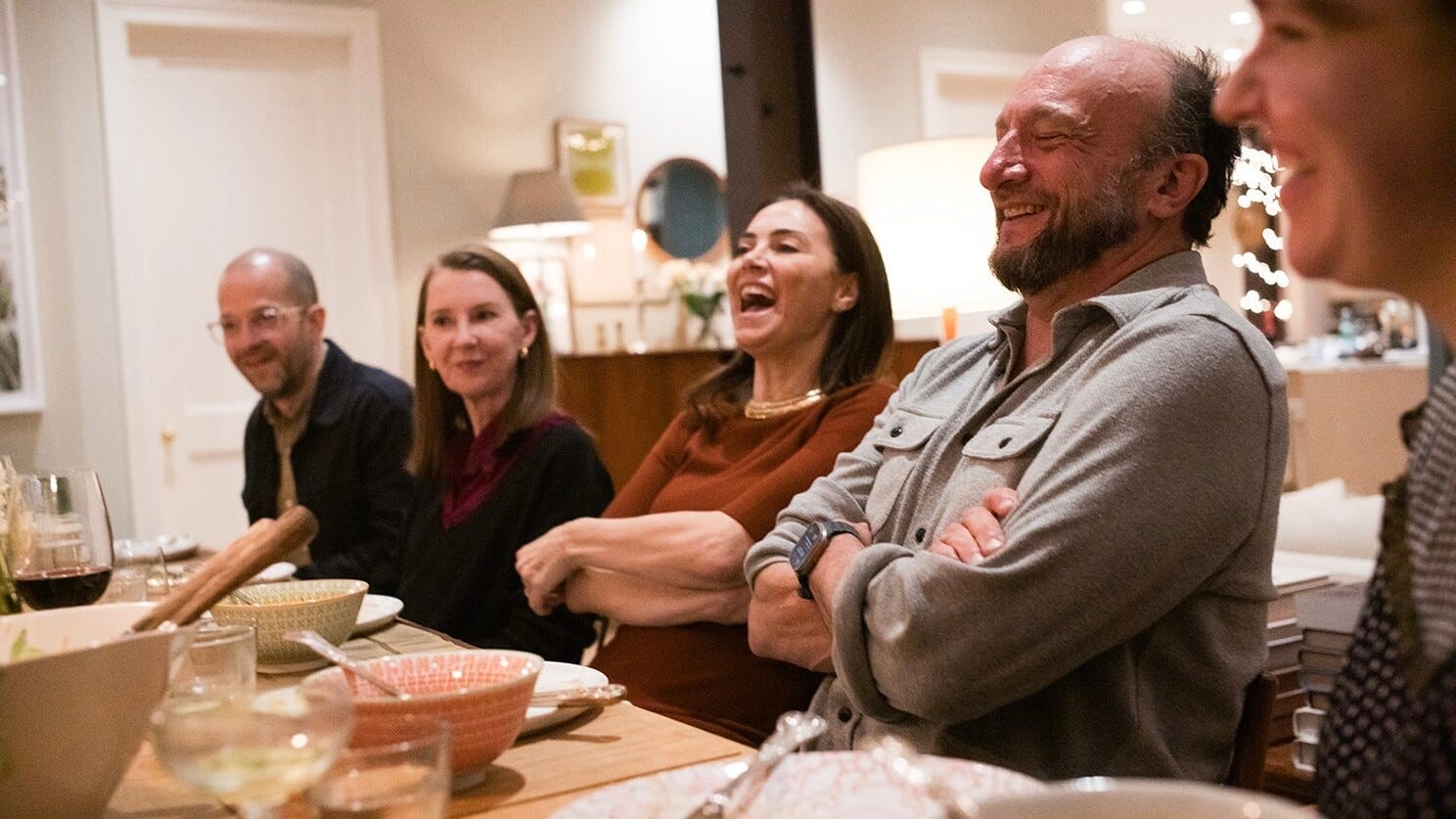
This week, one of our favorite books of the season was published— Flourish: The Art of Building Meaning, Joy and Fulfillment, by Daniel Coyle. We threw a dinner party at our apartment on Sunday to celebrate Flourish, as well as the wonderful new book Mattering by Jennifer Breheny Wallace, published last month. It was attended by a phenomenal crew — Next Big Idea podcast super-guest Gretchen Rubin, Next Big Idea Club curator Susan Cain, Penguin Random House EVP and editor, Andy Ward, NBIC co-founders Michael Kovnat and Panio Gianopoulos, his wife Molly Ringwald, NBIC member April Renae, and Dan’s daughter, Katie Coyle, and of course my wife Alisa Volkman.
This is how Dan describes flourishing groups in his new book —
They possessed a vibrancy, a switched-on responsiveness that showed up in their bodies. Their posture, in general, was relaxed; their heads were up and their interactions were fluid. Aliveness was the word I kept writing in my notebook: a feeling of being carried along in a river of energy that was headed somewhere good.
The evening, which included stories about when, in our own lives, we have felt that we mattered, and the times in our lives when have flourished, was for me exactly what Dan described — a state of “vibrancy, of switched-on responsiveness,” both fluid and alive.
There are many revelatory insights in this book — and in the conversation Dan and I had on our podcast. I am going to share what I believe to be the three core insights:
First, all flourishing is group flourishing. As Dan puts it, “there aren’t any flourishing hermits.” Though the self-help movement deserves to be taken seriously, in my opinion, as a powerfully positive American innovation — Ben Franklin was arguably our first self-help guru, as Walter Isaacson and I discussed recently — it suffers from what I like to call a “pronoun problem.” Self improvement should not be a solitary journey — optimize your habits, hack your morning routine, find your why. These are, more often than not, lonely and frustrating endeavors. WE should improve ourselves in communities. It’s more effective, and a heck of a lot more fun.
Second, “The type of attention we bring to the world changes the world we find.” This is a quote from the British psychiatrist Iain McGilchrist who explains that our brains evolved to shift between two types of attention — narrow controlling attention, and broad connective attention. We need both, but we only open our eyes to the people around us, and the opportunities to connect and collaborate — opportunities to flourish! — when we open ourselves up to connective attention. Our modern frenetic world has hijacked our attentional system, causing us to spend way more time than we should in a narrow, controlling attention mode. This limits our opportunities to connect, collaborate, and experience transcendent joy. How do we fix this? How do we develop what Dan calls “attentional health“? We engage what Dan calls “awakening cues” to shift out of our controlling attention myopia, and broaden our gaze to enjoy the rewards of connective attention.
Third, you will know you are flourishing when you feel “bursts of aliveness that make life richer and deeper, illuminating parts of [yourself] that you’ve forgotten existed.” You will know it when you experience “presence — the sense of living, breathing connection to something greater than yourself.” This tends to happen in the company of other people when there is looseness, slack in the system, comfort with a little bit of chaos. Flourishing groups “possess a vibrancy, a sense of responsiveness that shows up in their bodies. Their posture, in general, is relaxed; their heads are up and their interactions are fluid.” They are alive.
This reminds me of the great Oscar Wilde quote, “To live is the rarest thing in the world. Most people just exist, that is all.”
If you would like to experience more aliveness, more flourishing, order a copy of Flourish, listen to my conversation with Daniel Coyle, and let us know what you think in the comments below.
Wonderful piece, sound wisdom, let’s make it a movement. We are modeling next week as it complements our efforts to “Finish Well Beyond 50”. Thanks for all you do. Listened to the bite last week and have book in hand.
Hi Rufus- I 100% agree with your response to Liz. I spent my entire career in the teaching profession. One of the questions that frequently surfaced was: is effective teaching a science or an art? The consensus often reached is that it is a combination of the two. Similarly, if we apply one of Dan's concepts, effective teaching requires both controlling attention and connective attention.