
She Was About to Make Partner at a Top Law Firm. Then She Asked Herself One Question and Quit.
Cate Hall went from corporate law to the top female ranking in world poker to running one of the largest philanthropic foundations on earth. Here are her five practices for living the life you want.


The Big Idea: The biggest obstacles to the life you want aren’t usually external. They’re the stories, blind spots, and fears you’ve never questioned. There’s transformative power in seeking out uncomfortable truths, learning to tolerate rejection, and walking toward what feels most cringe-worthy.
Why It Matters: Most people limit themselves by avoiding what scares them, taking only the most obvious path, and staying silent when speaking up feels awkward. While that way of living may feel comfortable, excess caution compounds over time, and you may find your life is nothing like the one you wanted.
Try This Today: Ask one person what they thin is your most obvious flaw. Then actually listen to the answer instead of explaining it away.
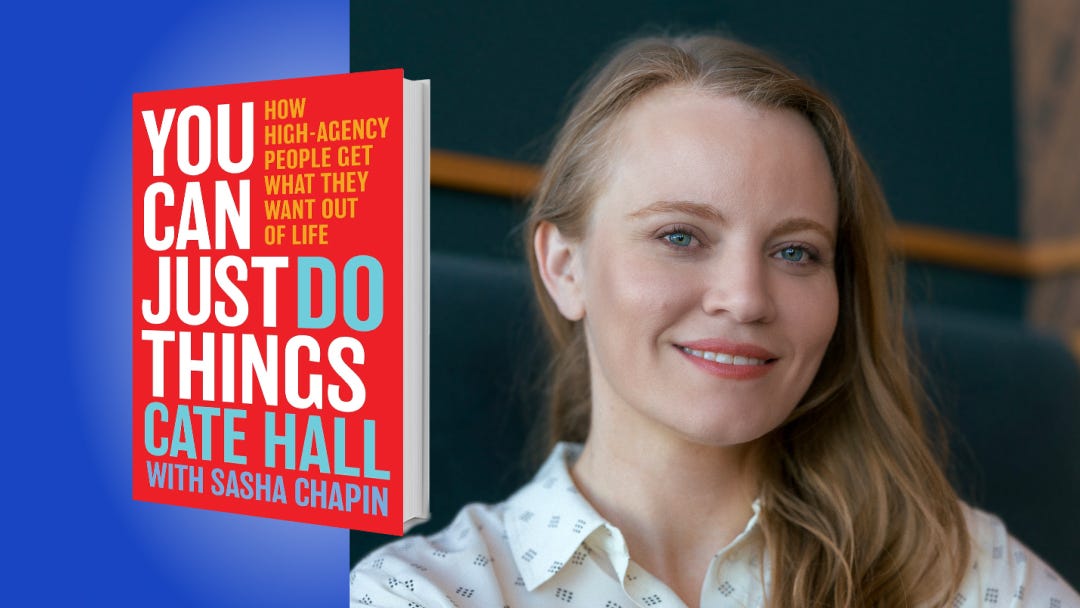
These ideas come from You Can Just Do Things: How High-Agency People Get What They Want Out of Life by Cate Hall, with Sasha Chapin. Cate is a writer, entrepreneur, and philanthropist whose career has spanned corporate law, professional poker (where she reached the top female ranking in the world) and nonprofit leadership, including serving as CEO of one of the world’s largest philanthropic foundations. Read on for five of her big ideas.
Get the best new nonfiction sent right to your door.
1. Living without feedback is like cooking without tasting.
Most of us have at least one limiting flaw we don’t know about—something obvious to most people within the first 10 minutes of meeting us. Don’t you want to know what that is? This is the lowest-hanging fruit in self-improvement.
You can collect real feedback by asking for it in your closest relationships, but not everyone will give it to you honestly. Even those who know you intimately may find it hard to be fully candid. This is why I have an anonymous feedback box attached to my social media, where anyone can leave me comments. I get some unhinged messages, as you’d expect, but the results have been life-changing. Coworkers have kindly informed me about rough edges in my management style. Someone recently wrote me a harsh message about how my wardrobe needed improving, and I realized they were right. Now I’m that much more stylish.
The most transformative thing about it, though, hasn’t been any single piece of advice. It’s been knowing that I’m no longer hiding the truth from myself. If you don’t actively collect real feedback, you’ll never know where your blind spots are—and they’ll keep quietly shaping your life without your permission.
2. Remove your rejection-sensitivity goggles.
Most of us fear rejection. We’re overly sensitive to social disapproval even when we intellectually know it is not the end of the world. As a result, we view the world through rejection-sensitivity goggles. We decide what to ask for by trying as hard as possible to avoid rejection. We ask to be paid only what we know everyone will be happy to pay. We invite people to hang out with us only when we’re sure they’ll say yes. The problem is you don’t know what’s reasonable until you run up against rejection.
“We’re overly sensitive to social disapproval.”
The less you fear rejection, the less stress you will transmit while making a request, which makes it more likely to be granted. I’ve sent some truly audacious emails in my life. When I was job-hunting once, I emailed someone who ran a nonprofit and essentially said: “I’m considering starting an organization like yours. What if I ran yours instead?” The reaction was not as negative as you’d think. Being borderline delusional on occasion has helped me make requests that are bold and sometimes granted. You won’t know if your ask is unreasonable until you try.
3. The abyss is your friend. Stare into it.
For a long time, I ignored the question of whether I actually wanted to be a lawyer. I raced through law school and climbed the ladder simply because I was desperate for approval and prestige—until I’d nearly made partner at one of the country’s top law firms. If I hadn’t finally, one day, fully confronted the question—Do I actually want this?—I’d be like a lot of my former peers: at the top of the legal profession, rich, comfortable, and miserable.
Most of us push hard questions out of our heads. Is this creeping unhappiness telling me to change careers? Is this activity I call ‘self-care’ actually a harmful addiction? Would I want my future children to know I’m making this ethical compromise? Sitting with uncomfortable questions like these is a skill that you can hone. It takes patience, quiet, and the willingness to be uncomfortable. If you can do it though, you’ll either come away with the motivation to change your life or assurance that your life actually does measure up to your conscience.
This week’s Book of the Day sponsor is No Experience Necessary by Ronnen Harary, co-founder and former CEO of Spin Master. At 23, fresh out of college and living at home, Harary built what became a global powerhouse behind PAW Patrol and Bakugan — and he argues his inexperience was the secret. Structured around eleven principles, the book reframes youth’s risk tolerance, energy, and openness as superpowers that young dreamers squander at their peril. Publishers Weekly calls it “a powerful corrective to the myth that experience is a prerequisite for success.”

4. You don’t have to live in movie logic.
Many film plots only work because characters are terrible communicators. Romantic comedy plots, for instance, hinge on protagonists’ inability to discuss their feelings. This makes for good screenplays, but you shouldn’t live as though you’re waiting for a plot twist to reveal the truth.
And yet, in dysfunctional organizations, friendships, and marriages, people almost never name the uncomfortable dynamic that everyone in the room is already feeling. What does the alternative look like? It looks like stepping outside the frame and saying what would be obvious to the observer. Things like:
I always feel a little awkward around you and I’m worried it comes across as me not liking you. I just wanted to say that’s not the case.
I’ve been sensing some low-level tension between us. Maybe we’re quietly annoyed at each other but trying to stay polite. Is that just me?
It sometimes seems like when I push back in meetings, it changes the energy in the room—like maybe you’re afraid to engage with me as directly as you do with others. Does that feel true?
Naming awkward dynamics almost always brings relief. Everyone is already feeling and living through the dynamic. By bringing it out into the open in a non-aggressive way, you can address it rather than mistaking silence for diplomacy.
Momentous — If you want to try Momentous Signature Spec Creatine, head to livemomentous.com and use code IDEA for up to 35% off your entire first order.
5. Cross the cringe minefield.
People naturally double down on their strengths. Why wouldn’t they? Energetic, disciplined types gravitate toward punishing exercise routines and demanding jobs. Novelty seekers move to new cities and become bartenders or traveling salespeople. And this applies to self-help, too: We read books and take advice that flatters our default style.
The problem is this eventually leads to dead ends—places in life where it feels like you’ve tried everything. But you haven’t tried everything. You’ve tried everything that doesn’t require feeling the forbidden feeling—the one core fear your whole adult personality is built to avoid. Maybe it’s worthlessness or loneliness or mediocrity. Whatever it is, any path that runs through it gets rejected out of hand or never even seen as an option. I call this barrier the cringe minefield.
“Your core fear walls off the parts of you that you’ve never let develop.”
For me, the fear is being selfish or corrupt. For a long time, that fear made me unable to compliment my own husband, because some part of me insisted that doing things he would enjoy was manipulation. It made negotiating for pay more difficult, because asking for what I was worth felt like confessing filthy greed.
Crossing those minefields was mortifying. It was also where my fastest growth came from, because your core fear walls off the parts of you that you’ve never let develop. Figure out what your core fears are and get suspicious that there might be treasure lurking on the other side.
 | A guest post by
|