
The Hidden Science of Midlife
A Brandeis psychologist draws on 30 years of longitudinal data to show why midlife isn't a crisis — it's the most important investment opportunity of your life

The Big Idea: Midlife isn’t a slow fade — it’s the biological and behavioral moment that quietly sets the terms for everything that comes after.
Why It Matters: For decades, middle age has been framed as either a crisis or a punchline. Meanwhile, researchers have been quietly accumulating something more valuable: data. Brandeis psychologist Margie Lachman has spent over 30 years following thousands of American adults through midlife and beyond, and what she’s found cuts against the cultural narrative. How old you feel, how much you move, how well you sleep, and how connected you are in your 40s and 50s are strong predictors of later-life health. Midlife isn’t a holding pattern, it’s the leverage point.
Try This Today: Calculate your “subjective age”: ask yourself how old you feel on a typical day — then notice whether that number is running ahead of or behind your birth certificate, and what’s driving the gap.
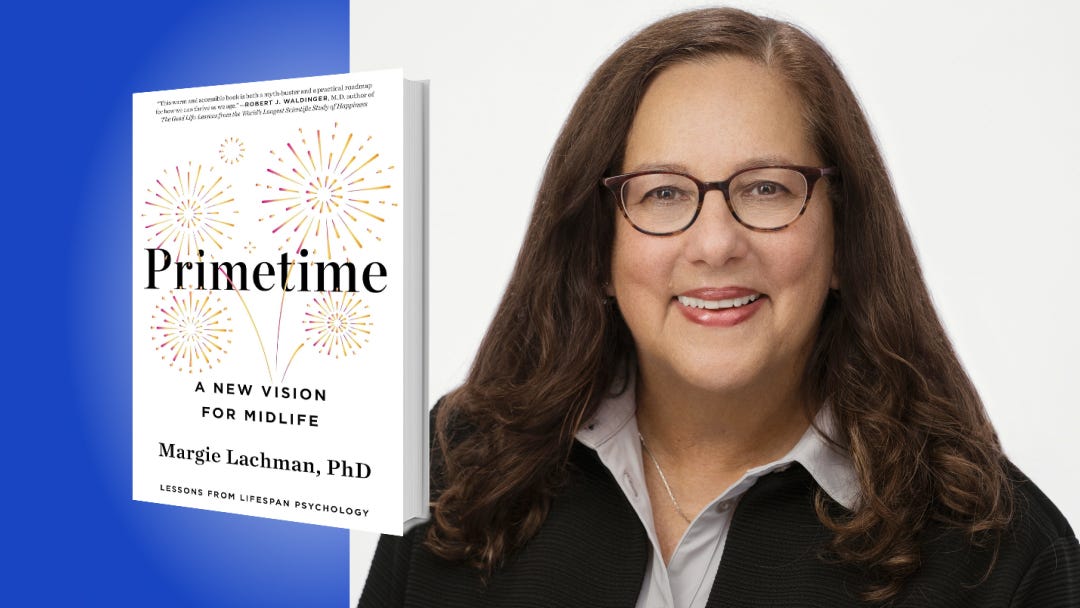
These ideas come from Primetime: A New Vision for Midlife by Margie Lachman. Margie is a professor of psychology at Brandeis University and a lead investigator on the Midlife in the United States (MIDUS) study, which has tracked thousands of adults for over 30 years to map the pathways to health and well-being across the life span. Read on for 5 of her big ideas.
1. Midlife is a pivotal period in the life course.
Whenever I tell someone I study midlife, the first question is, “When is midlife?” The 30- and 40-somethings wonder, “Am I considered middle-aged?” Those in their 60s and 70s wonder whether they still qualify. The heart of midlife is the 40s and 50s, but the broader range is 40 to 60, plus or minus 10. That’s because many people in their 30s and 60s think of themselves as middle-aged. Subjective age, or how old one feels, is important to consider because it is closely associated with health and well-being. In the large national longitudinal study Midlife in the United States (MIDUS), which I have worked on for over 30 years, we found that the older you are, the later you think midlife begins and ends. Yet midlife isn’t only about the number of candles on your birthday cake.
Regardless of the exact ages you believe middle age begins and ends, we believe that midlife is the hinge point between the first and second halves of our lives. Who we were before and who we want to become after middle age presses in on us from both sides. And the opportunity to positively impact others is one of the most pivotal aspects of midlife.
Midlife is a time when you likely hold more roles and responsibilities than at other times. There can be an intense feeling that everyone is counting on you for so much. It’s caring for your kids while also helping your aging parents. It’s advising junior and senior colleagues at work. You’re literally in the middle, pulled in many directions. That’s the essence of midlife. It’s less about your chronological age and more about how you feel in your unique and often challenging position between generations at home, at work, and elsewhere.
Get the best new nonfiction sent right to your door.
2. There are many facets of age.
Knowing someone’s chronological age doesn’t tell you much except how long they have lived. Although born in the same year, people of the same age will vary in their life circumstances, and these differences become more pronounced over time. There are more meaningful ways to think about age that can provide useful information about someone’s quality of life and health span. One is subjective age, or how old you feel. In MIDUS and other studies, we find that most healthy adults feel significantly younger than their birth certificate says they are. People aged 40 and above who are healthy typically say they feel about 20 percent younger than their age. So, if you are 40 and in good health, you are likely to feel like you are in your early 30s, and if you are 50, you may feel like you are still 40.
Biological age captures physical health across many dimensions, such as hand-grip strength, lung function, walking speed, blood pressure, and telomere length (DNA at the tips of a chromosome), and compares your results to those of people who are younger or older. If you are 55, your biological age might be younger than your chronological age if your test results resemble those of the average 45-year-old. Formulas are also used to predict your pace of aging, showing that some people age faster than others at the cellular level. We can also measure your brain age using brain scans to calculate brain volume and cortical thickness relative to your chronological age. A younger brain age is associated with fewer signs of cognitive impairment or dementia.
As biomarkers of age continue to become more reliable, there is a growing market for longevity clinics, which offer extensive workups and diagnostics with the aim of providing information to help slow or even reverse the aging process. Although the quality of these assessments varies, they can provide useful information that can lead to adaptive lifestyle changes and personalized interventions. And who wouldn’t feel great if their results show their biological age is younger than their actual age? These other indicators of age can tell us more about what’s in store for our health than chronological age alone because your subjective age, biological age, and brain age reflect your functional capacity, your wear and tear. If you can do the things you want to do, then you feel young. If not, you feel old. Your birth certificate is an official record, but what matters is whether you’re living the healthy life you want.
3. Social relationships are good for health.
In midlife, we have many responsibilities for others in the family, at work, and in the community. It can be overwhelming and exhausting. Yet, caring and concern for others is a midlife specialty. The famous psychoanalyst Erik Erikson identified generativity as the central task of midlife. It’s this deep concern for the next generation—not just your own kids, but younger colleagues, students, and people in your community.
Mentoring is a classic example. You’ve accumulated all this knowledge and experience, and there’s this powerful drive to pass it on. It’s how we transcend our own mortality and create a legacy. Our impact continues through the people we’ve invested in.
It’s not just the recipients of support who benefit. Providing support to others can bring satisfaction, a sense of purpose, and health benefits to the giver. One word of caution, though: It is easy to get caught up in supporting others, but you also need support. A balance between giving and receiving support is important for health and well-being.
According to the Pew Research Center, about a quarter of adults are providing care for a child under 18 and a parent over age 65, a group often called the sandwich generation. This can be stressful as it pulls people in so many directions and leaves little time for leisure or alone time. Keep in mind that it’s also important to accept help from others, whether it is tangible support or emotional support.
Introducing the First Look Club — our early-reviewer program for the most curious readers. Members get free advance copies of standout new books before they hit shelves, read them first, and help decide which ones we champion next. There’s no cost and no catch. Sign up and we’ll email you the moment new books open up.

4. Focus more on the gains than on the losses.
In their 40s, many notice early signs of aging tied to physical changes, such as thinning or graying hair, the need for reading glasses, slower reaction times, and aches and pains that take longer to heal. Our culture values looking young, which fuels the multi-billion-dollar anti-aging industry, including Botox, plastic surgery, hair dye, hair transplants, anti-wrinkle skin products, and longevity supplements. People typically focus on the physical and cognitive changes that come with age and think it’s all downhill after 40. Such negative aging stereotypes aren’t just annoying; they’re dangerous. Research shows they can literally affect lifespan.
In midlife and beyond, there are tremendous gains still happening in many areas such as self-confidence, emotion regulation, knowledge, and problem-solving. For people in midlife now, focusing on maintaining or improving health and well-being for oneself and one’s loved ones is so important given how “out of control” the outside world can feel. The good news is that you can choose how you process and respond to the challenges of aging. A psychosocial prescription for healthy aging includes positive attitudes such as a sense of control, purpose in life, and optimism, which are important as they can reduce stress and motivate and sustain health-promoting behaviors that contribute to better physical and cognitive health in later life.
What we make of midlife is largely up to us. Making the most of it can bend the curve toward healthy, productive aging. The key is what you do with what you’ve got. “Use it or lose it” isn’t just a catchy phrase; it’s a physical reality. Your brain, your muscles, and your social connections all respond to investment. Being gain-framed means asking, “What can I improve?” instead of “What am I losing?”
Midlife is an opportunity. It’s a golden chance we should seize. It is a time to make sense of the past and sow the seeds for the future. If you view midlife through the lens of opportunity, everything changes for the better.
5. Investments in midlife health pay big dividends.
What happens in midlife doesn’t stay in midlife. There is growing evidence that midlife health indicators may be more important for later-life health and longevity than the same indicators at older ages. Blood pressure, lung function, glucose levels, cholesterol, sleep, physical fitness, and weight in midlife are strong predictors of health and cognition in later life.
Health in midlife provides a window on later life and can inform preventative interventions to optimize functioning and health span. There is a great deal of interest in identifying modifiable beliefs and lifestyle factors that can promote healthy aging. Results from many studies provide convincing evidence that addressing risk factors in midlife and adopting adaptive behaviors, such as engaging in physical and cognitive activity, can yield long-term benefits for health outcomes and longevity.
Middle age is an ideal time to make lifestyle changes to increase health span. If you want to make one lifestyle change with widespread benefits, physical activity is a panacea. You would have to be hibernating or living in a bubble not to know that physical exercise is important for your health. Yet only about a quarter of adults in midlife engage in the recommended amount of exercise: at least 150 minutes a week of moderate-intensity activity, such as brisk walking, and at least two days a week of muscle-strengthening activities.
Exercise has remarkable benefits for physical, cognitive, and psychological health. Those who engage in regular exercise have a reduced risk of cardiovascular disease, cancer, frailty, dementia, and depression, and they live longer. There are many types of exercise that are beneficial. It doesn’t have to involve expensive equipment or joining a gym. The earlier you start, the better, although it’s never too late to begin.