
What If We Fired All the Politicians?
A Yale professor makes the case that ordinary citizens can govern better than the people we elect.

The Big Idea: Democracy doesn’t have to mean choosing between flawed politicians every few years—it can mean putting ordinary people directly in charge, and the results are better than you’d expect.
Why it matters: Most of us assume that governing is best left to professionals. But the evidence tells a different story. Across hundreds of real-world experiments, randomly selected citizens—teachers, shopkeepers, farmers, engineers—have consistently produced fairer, more creative, and more widely accepted policy than elected politicians. The problem with democracy isn’t the people. It’s the selection mechanism.
Try this today: Think of one political issue that frustrates or overwhelms you. Now imagine sitting in a room with 150 strangers from all walks of life, spending a weekend learning about it from experts, then debating it openly. Would your opinion shift? Would theirs? That’s the experience at the heart of citizens’ assemblies—and it’s already happening around the world.
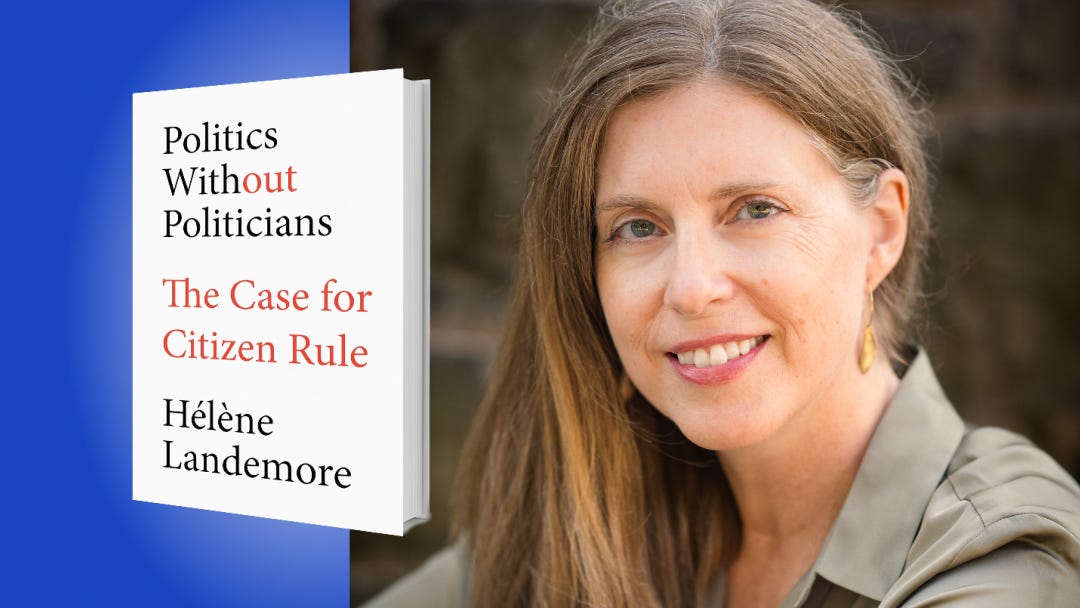
These ideas come from Politics Without Politicians: The Case for Citizen Rule by Hélène Landemore, professor of Political Science at Yale University and one of the world’s leading thinkers on participatory democracy. Below, she shares five key insights for reimagining what democracy can look like—and why the shy, the skeptical, and the fed-up might just be its best hope.
1. Elections are the problem.
Most people think periodic elections are the end-all and be-all of democracy, but they are not. Elections are, in fact, a mechanism that systematically selects for those who are power-hungry, corruptible, wealthy, socially connected, and often the boldest and most arrogant. Meanwhile, they leave out those I call “the shy”—namely, all the people who are turned off by this battle of egos and are made to feel irrelevant and powerless.
The result of our ideological commitment to elections is that we end up, time and again, with politicians who look the same, think the same, have enormous blind spots as a group, and cannot deliver fair or good governance. Most of the time, the political class is not even responsive to what majorities want. Instead, they are overly responsive to what rich and educated people want, leaving us at best with democracy by coincidence.
Note that getting rid of elections as a mechanism for the selection of representatives does not mean getting rid of voting altogether. Of course, we’d still want the possibility of voting on issues going forward.
2. Citizens’ assemblies are a key part of the solution.
Citizens’ assemblies are large bodies of randomly selected citizens gathered for a sustained period—typically a few weekends, sometimes months—to deliberate about policy issues. The selection mechanism for this type of assembly is lot, not election. People are selected based on “one person, one lottery ticket” rather than “one person, one vote.” This yields assemblies that, when large enough, end up looking like the rest of the public in all its diversity. Citizens’ assemblies include 50 percent women by default and every group in proportion to their size in the larger public—a marked advantage if you’re trying to figure out what problems people have and how best to solve them.
Taking part in such assemblies is like jury duty on steroids, except people really enjoy it. They are paid for their time, reimbursed for their costs (including childcare), and supported in their work by facilitators and experts. They learn a lot and get to play a key role in the political life of their country.
“The selection mechanism for this type of assembly is lot, not election.”
This is not fantasy or science fiction. The Organisation for Economic Co-operation and Development (OECD) has documented close to 800 cases of deliberative bodies, selected by lot, and entrusted by governments with making policy recommendations. Some critics worry that ordinary citizens might lack the expertise or discipline to make good policy, but evidence shows the opposite. Citizens’ assemblies consistently produce thoughtful, workable, and socially just recommendations, often outperforming elected politicians in both quality and public acceptance. For example, in the French Citizens’ Convention for Climate, members proposed 149 alternatives to the carbon tax pushed by President Macron and the experts who testified before them—a solution that better reflected public values and avoided reigniting the Yellow Vests protests.
What’s striking is how quickly learning happens. Participants often arrive saying, “I know nothing about this.” But after just a few sessions—after listening to experts, questioning them, and debating among themselves—they begin speaking with confidence and nuance. By the final weekend, many are drafting proposals that balance competing values in ways professional politicians rarely manage, precisely because they’re not locked into party positions or electoral incentives.
There’s never been a better time to join the Next Big Idea Club. If you join now, we’ll send you a copy of A World Appears with a personal note from Michael Pollan, access to our thriving community of curious people, and an invitation to discuss the book with Michael himself in a live Zoom conversation on March 10th.

3. Politics can be joyful and welcoming.
Politics for many people evokes toxicity and conflict. But I like to think of it differently: as a welcoming hostess at a party. I borrow the image of this joyful female figure from the British essayist G.K. Chesterton, who defined democracy as “an attempt, like that of a jolly hostess, to bring the shy people out.” On that view, democracy is not a fixed set of rules; nor is it toxic and alienating. Instead, it’s an intentional effort, which has to be constantly renewed to encourage shy people to speak up and find their voice. By the shy, I don’t mean just the natural introverts, but anyone who feels disempowered by the current system.
Democracy as a jolly hostess isn’t just a metaphor. In the French Citizens’ Assemblies, people from all walks of life—teachers, shopkeepers, farmers, doctors, engineers, and homemakers—come together, with expert support, to discuss complex topics such as climate policy, abortion, and housing reform. Many arrive nervous or skeptical, unsure how their opinions matter. But by the end, they feel empowered, including the shyest participants, in part because they know more, but also because they feel more valued, more seen, and more heard.
4. Politics without politicians heals and reconciles people.
Politics without politicians is conducive to an emotion we’re used to seeing as entirely alien to politics as we know it: civic friendship, or more simply put, love. In the citizens’ assemblies I’ve observed, it is possible to experience politics as something that unites, bonds, and even reconciles people across party lines, age, culture, race, and other sources of division.
“Politics without politicians is conducive to an emotion we’re used to seeing as entirely alien to politics.”
Politics does not have to be about rage and resentment. Many people have gone through that transformative experience. There is the story of Jules, for example, the disgruntled climate skeptic from the French Citizens’ Convention for Climate, who took his carry-on everywhere with him during the first weekend because, as he put it, he was leaving any minute now, but who ended up staying until the end of the process and, when it was over, went to run for elections in his home region. I also tell the story of Finbar Obrien, an older homophobe, and Chris Lyons, a young flamboyant gay man, from the Irish Convention on the Constitution, who went from hate at first sight when they sat across each other on the first weekend, to solid friends by the end of the process.
What makes this possible is the curated context of deliberation among a diverse group of people under the right conditions. People are no longer arguing through slogans or social media avatars. They’re sitting across from one another, sharing meals, listening, and working toward a common task. They are encountering radical differences, sometimes for the first time, in a way that invites curiosity rather than judgment. Over time, political disagreement stops being existential. It becomes something you can live with and even respect.
This edition of Book of the Day is sponsored by Bitdefender. Get 30% off your plan at bitdefender.com/idea.
5. The six key rules of a jolly hostess.
Throwing a good party is an art. What’s striking is how fragile these processes can be when the rules aren’t respected. If experts dominate, if facilitators rush agreement, or if participants feel ignored, then trust evaporates quickly. Designing democracy well means paying attention to these small details because they’re what determine whether citizens step forward or retreat back into silence. Making politics welcoming isn’t just a matter of good intentions.
“What’s striking is how fragile these processes can be when the rules aren’t respected.”
How do you design and implement deliberative processes that work? I identify six behavioral norms—what I call the rules of a jolly hostess—that consistently make the difference between assemblies that work and those that don’t. They include, centrally, trusting citizens and sharing power with them. For example, your assembly is more likely to be successful if you let citizens have a say about the choice of experts invited to testify in front of them. I also explain, more broadly, what it means to design for inclusion—and how to handle dissent and disruption without undermining the process.
I absolutely agree with the premise of Hélène Landemore's book, Politics Without Politicians: The Case for Citizen Rule. I am absolutely certain randomly selected citizens would always deliver far better outcomes for the citizens they represent than professional elected politicians ever possibly could. Make it a lottery for registered voters....sometimes you get jury duty and sometimes you get to represent your fellow citizens.