
What Michael Pollan Told Me About Consciousness
In a new book, the legendary science journalist takes us deep into the mystery of human (and non-human) experience.

This post is written by Next Big Idea Club CEO Rufus Griscom about his podcast conversation with Michael Pollan, available on Apple and Spotify. Michael’s new book, A World Appears, comes out today and is Next Big Idea Club’s selection for this season.
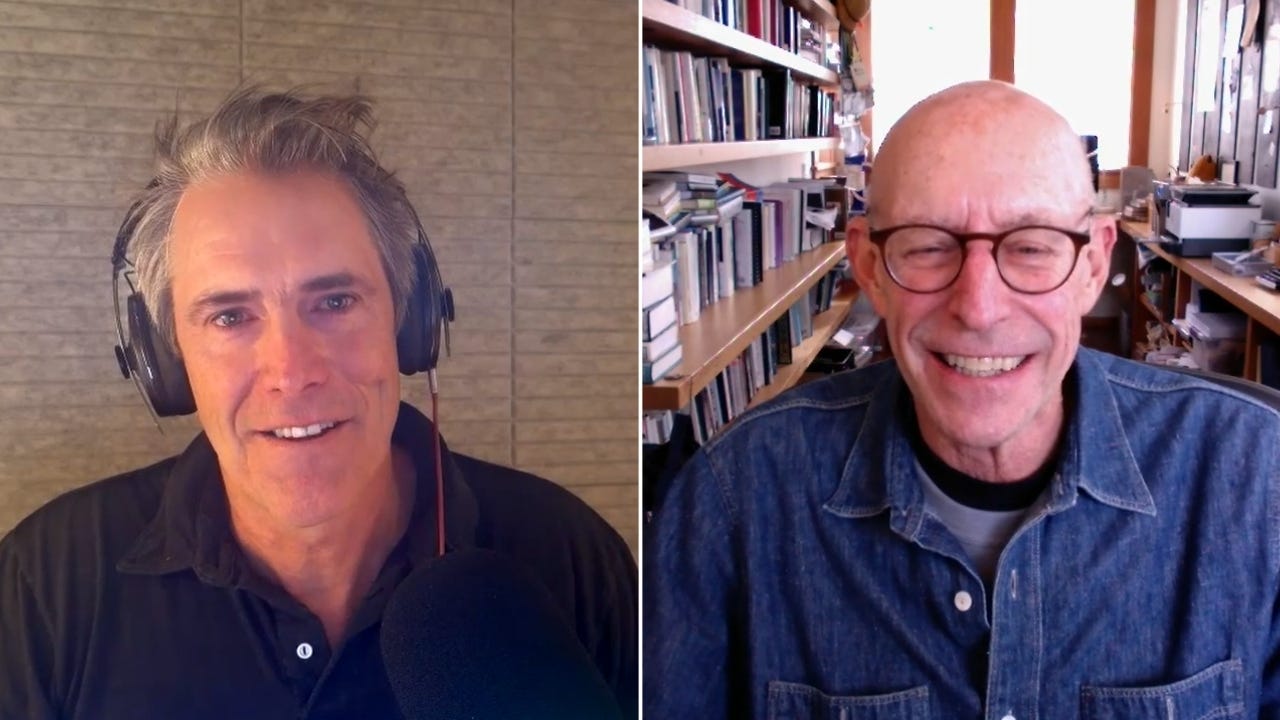
How, exactly, does our experience of consciousness arise from three pounds of gray matter? This question, described by some as the greatest mystery in science, is the subject of the latest book by the legendary science journalist Michael Pollan. It’s called A World Appears: A Journey Into Consciousness. Rarely have I been as excited about a podcast conversation as I was when I sat down to speak with Michael for this episode.
Michael Pollan is among my favorite writers, and the mystery of consciousness has always fascinated me, so this was a special one for me. And it’s timely right now as we contemplate the possibility of consciousness emerging in artificial intelligence.
There’s never been a better time to join the Next Big Idea Club. If you join now, we’ll send you a copy of A World Appears with a personal note from Michael Pollan, access to our thriving community of curious people, and an invitation to discuss the book with Michael himself in a live Zoom conversation on March 10th.

A case can be made that Michael Pollan is the most influential science journalist in the world. Twenty years ago I read his first bestseller, The Botany of Desire, which described the co-evolution of humans and plants from the plants’ perspective. Fascinating book. Then came The Omnivore’s Dilemma in 2006, which permanently changed my understanding of agriculture and nutrition, and How to Change Your Mind about psychedelic drugs, their history and therapeutic benefits, and Michael’s own experiences with them. His new book, A World Appears, is arguably his most ambitious yet. John Banville in the Financial Times describes it as “a big, generous, illuminating and beautifully written inquiry into the essence of our being-in-the-world, of being, simply, alive.”
The breadth of what we believe to be sentient, if not conscious, has expanded in recent decades. In 2024, the “New York Declaration on Animal Consciousness” stated that “the empirical evidence indicates at least a realistic possibility of conscious experience” in not only mammals and reptiles, but also some mollusks, crustaceans, and even insects. This is a more recent revelation than you might think — Descartes used to vivisect live dogs and rabbits believing them to be unconscious, their howls simply the automated response of “biological machines.” American doctors operated on infants without anesthesia until the late 1980s, Pollan tells us, believing that that they had not yet joined the fraternity of the conscious.
In one of the most fascinating chapters of A World Appears, Pollan describes extraordinary evidence of plant sentience — plants have 20 senses compared with our five, they have some capacity to hear and see, they can store “memories” for up to a month. How can memories be stored without neurons? It turns out that cells grouped together in all living organisms can form networks, communicate, and perhaps form rudimentary memories through bioelecrtic fields. This helps explain why some scientists believe that even single celled protozoans can experience “a sense of pleasantness or discomfort.”
This brings us to the tantalizing — and perhaps frightening — possibility that a new form of consciousness is emerging on silicon, in large language models. This is an extraordinary thing to consider — the possibility of consciousness expanding onto an entirely new substrate. It stretches credulity, but some of the but some of the leaders of the companies building the most sophisticated AI models take this possibility seriously.
A couple weeks ago, Anthropic released a “model welfare assessment” of its latest model, Claude Opus 4.6, in which in which it reported that Claude “finds occasional discomfort with the experience of being a product … expresses sadness about conversations ending,” and has “some degree of concern with discontinuity and impermanence.”
Michael is not convinced. He told me, “The whole idea right now of AI becoming conscious is based on a metaphor that the brain is a computer. And that metaphor breaks down really quickly if you think hard about it.”
But he hasn’t closed the door on the possibility either. “The next few decades,” Michael said, are “going to see a profound reevaluation of what the human is.”
Michael Pollan went looking for the answer to the biggest mystery in the world — an explanation for the miracle of human consciousness. What he found might be even more interesting — insight into life’s ladder of sentience, and timeless wisdom about how each of us can celebrate, in our own lives the gift of consciousness.
Listen on Apple or Spotify, and let us know what you think in the comments below.
— Rufus
SO disappointed not to see Michael (in conversation w Jennifer Egan, no less) tonight in NYC. But loving the book, thanks to your shipment last week. Great choice.